To launch a recurring revenue model in WooCommerce, store owners traditionally face a stark choice: pay $279 annually for the official WooCommerce Subscriptions extension, or rely on heavily restricted trialware. Swift Commerce provides a genuine free alternative on the WordPress.org repository. It delivers native recurring billing, prorated plan switching, and customer self-service portals without injecting unnecessary code or demanding an expensive upfront license.
Establishing a Monthly Recurring Revenue (MRR) framework is the most effective way to scale an eCommerce brand. When revenue resets to zero at the beginning of every month, forecasting inventory and marketing budgets becomes incredibly difficult. Subscriptions stabilize cash flow, drastically increase Customer Lifetime Value (CLV), and lower overall Customer Acquisition Costs (CAC). However, the barrier to entry in the WordPress ecosystem has historically been too high for new merchants.
This comprehensive guide breaks down the financial and technical flaws of traditional subscription plugins and explains how the free tier of Swift Commerce provides every feature necessary to build, manage, and scale a subscription business without compromising site speed.
The Financial Burden of Traditional Subscription Stacks
The WooCommerce ecosystem operates on a structural contradiction. While the core platform is open source and free, achieving professional functionality requires purchasing dozens of premium extensions.
If a store owner wants to offer a monthly coffee delivery service, the official WooCommerce Subscriptions plugin requires an immediate $279 annual investment. If that same owner wants to allow customers to bundle their subscriptions with standard products, they often need to purchase another add-on. If they want advanced checkout editing to streamline the sign up process, that is yet another annual fee.
Within a few months, a merchant can easily spend well over a thousand dollars annually just to maintain basic site functionality. This financial drain forces business owners to allocate capital to software licenses rather than investing in marketing, product development, or customer acquisition.
Swift Commerce was built to eradicate this financial barrier. The free version available on the WordPress repository is not a limited demo. It is a fully functional, production-ready subscription framework designed to help merchants launch their recurring revenue models without upfront financial risk.
Eradicating Technical Debt and Database Bloat
The cost of traditional plugins is not merely financial; it is heavily technical. Stacking multiple standalone plugins degrades your site speed and creates a fragile infrastructure.
Every time a merchant installs a new, isolated plugin for subscriptions, cart recovery, or product bundles, that plugin writes unique rows of data to the wp_options table in the WordPress database. When the autoload value for these rows is set to “yes,” the server is forced to load this data into memory on every single page load. It does not matter if the customer is viewing a subscription product or reading a blog post; the server carries the weight of that plugin everywhere.
This autoload bloat is a primary cause of severe Time to First Byte (TTFB) delays. Furthermore, recurring billing relies heavily on background processing to trigger renewal orders. When you have multiple fragmented plugins attempting to hook into the WordPress database simultaneously, you create query multiplication that can stall your server during peak traffic hours.
Swift Commerce solves this by consolidating sixteen essential eCommerce features into a single, unified codebase. By replacing fragmented tools with one optimized framework, merchants drastically reduce their database queries and minimize autoloaded data. This results in faster load times, higher Core Web Vitals scores, and a checkout experience that never freezes under pressure.
Breaking Down the Swift Commerce Free Tier
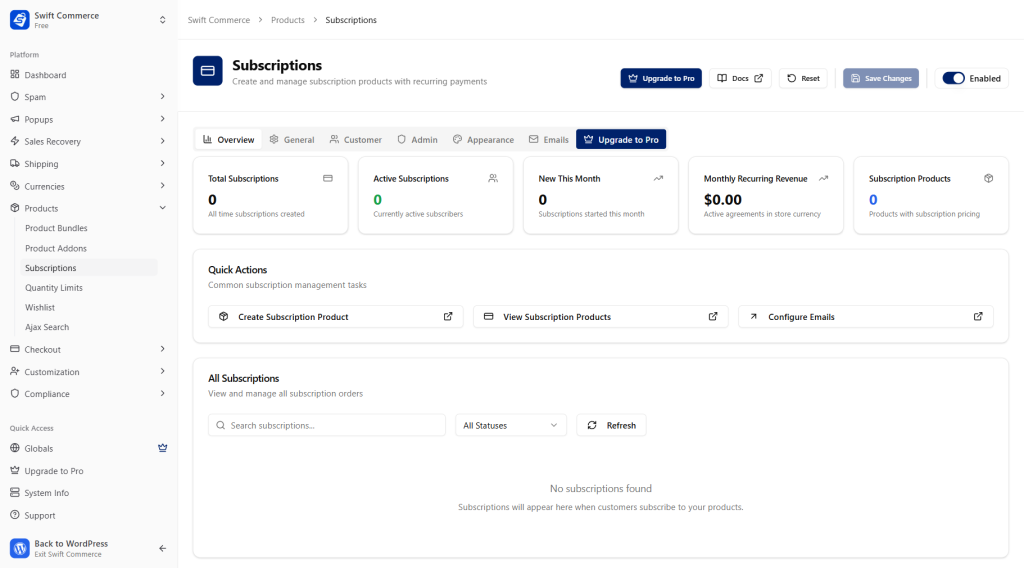
When evaluating a free alternative for WooCommerce subscriptions, merchants must look beyond basic recurring billing. True subscription management requires handling complex customer edge cases securely. The Swift Commerce free tier includes a robust suite of features that competitors typically lock behind premium paywalls.
Subscription Creation and Variable Products
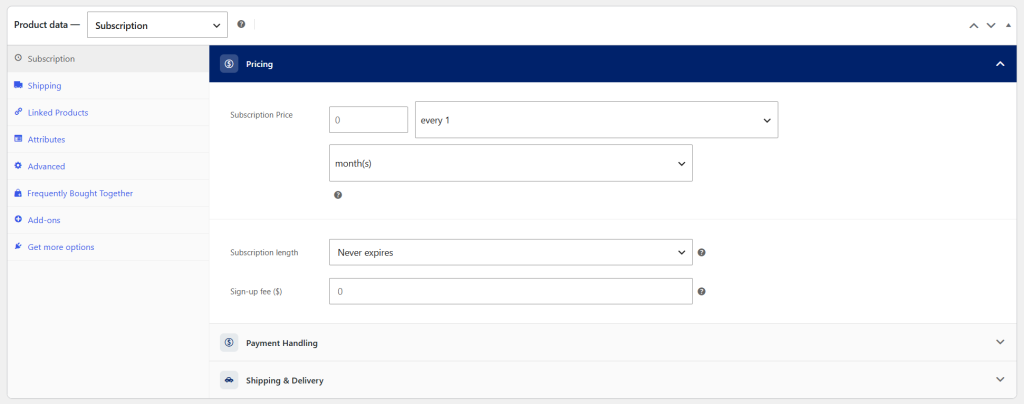
The foundation of the free tier is absolute flexibility in product creation. You can transform any simple product into a recurring subscription with just a few clicks. More importantly, the free version fully supports variable subscription products.
If you sell a software license, you can offer a “Basic” tier for $10 a month and a “Premium” tier for $25 a month within the same product page dropdown. This allows for a clean, consolidated shopping experience without cluttering your catalog with duplicate product listings.
Sign Up Fees and Length Limits
Many business models require an initial setup cost. If you are selling a subscription box that includes proprietary hardware in the first shipment, you cannot afford to absorb that cost into the standard monthly fee.
The free version includes native support for Sign up fees. You can charge a one time $50 fee on the initial checkout, followed by a standard $15 monthly recurring charge. Additionally, you can enforce Subscription length limits. If you are selling a twelve month coaching program, you can configure the subscription to expire automatically after the twelfth payment, ensuring the customer is not billed indefinitely.
Empowering the Customer: Pause, Resume, and Cancel
Customer churn is the enemy of recurring revenue. When a buyer has too much product stockpiled, their first instinct is to cancel their subscription. Once they cancel, the probability of them returning drops drastically.
To combat this, your store must offer self service tools. The free tier of Swift Commerce transforms the standard WooCommerce “My Account” page into a comprehensive management dashboard. Customers can manually Pause, Resume, or Cancel their active plans without needing to email your support team. Allowing a customer to pause a delivery for one month preserves their payment token and keeps the long term relationship intact, effectively lowering your involuntary churn rate.
Plan Switching and Payment Proration
Handling upgrades and downgrades manually is an accounting nightmare. If a customer is halfway through a $50 monthly subscription and decides to upgrade to a $100 monthly tier, forcing them to pay full price immediately creates massive friction.
Swift Commerce handles Plan switching and Payment proration completely free of charge. The system calculates the exact monetary value of the unused time on the original plan and applies it automatically as a credit toward the upgraded plan. Managing this complex logic seamlessly for the end user is a hallmark of a professional setup, and it is available right out of the box.
Frictionless Buying with Mixed Checkouts
Many legacy subscription plugins force customers to buy recurring items separately from one time items. This creates a terrible user experience. If a customer wants to buy a monthly coffee subscription and a one time ceramic mug, they should not have to check out twice.
The Mixed checkout feature is fully supported in the free tier. Customers can add standard retail products and recurring subscription products to the same cart. The system intelligently separates the initial payment totals from the future recurring totals, displaying everything clearly on the checkout page. This dramatically increases your Average Order Value (AOV) by removing artificial purchasing barriers.
Shipping Frequency Overrides
Logistics for subscriptions can be highly specific. Sometimes, the billing frequency does not match the shipping frequency. A customer might pay a $100 annual fee but receive a physical box every single month. The Shipping frequency override feature allows merchants to decouple the billing cycle from the fulfillment cycle, providing total logistical control over how and when products leave the warehouse.
Customization and Email Notifications
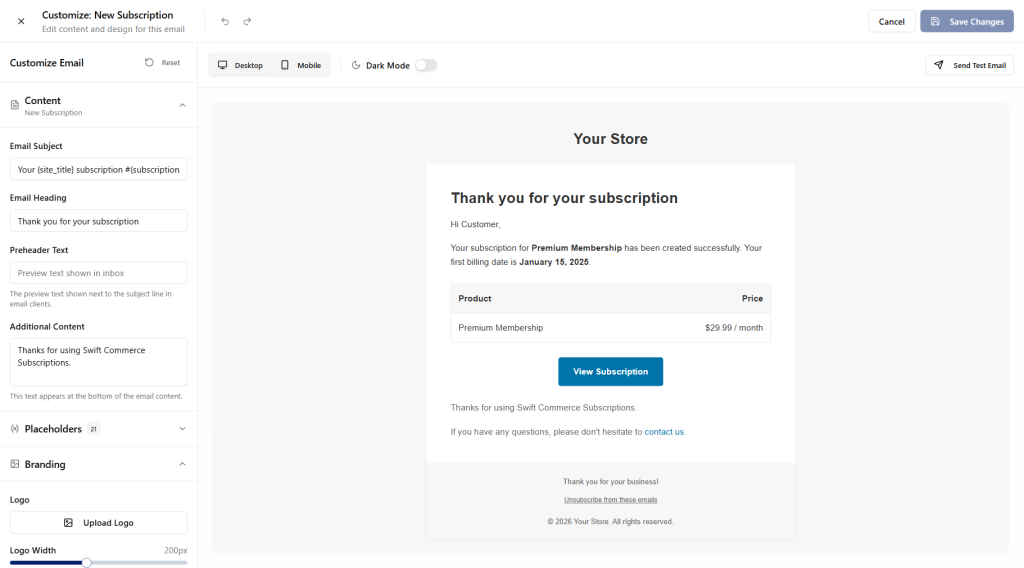
Communication is critical for subscription retention. Customers must be notified when their renewal is approaching or if a payment fails. The free version includes automated Email notifications that hook directly into the WooCommerce email system. Furthermore, it provides extensive Customization options, allowing you to tailor the text, buttons, and design of your subscription management portals to match your brand’s unique identity perfectly.
You also retain the administrative power to Delete subscriptions cleanly from the backend, ensuring that your database remains organized if you need to purge old or test data.
Scaling Smart: When to Upgrade to Pro
The philosophy behind Swift Commerce is simple: Start simple, scale smart. The free version provides the entire foundation required to generate, manage, and optimize recurring revenue. It is not designed to force an immediate upgrade.
Merchants should only consider the Pro version when their business model matures and requires specific, advanced enterprise logic. The Pro version introduces two highly specialized features for complex scaling:
- Free Trials: Offering a seven day or fourteen day free trial is a powerful acquisition strategy for digital products and software. The Pro version automates this logic, capturing the payment token upfront but delaying the initial charge until the trial period explicitly ends.
- Synchronize Renewals: For merchants running massive subscription box operations, billing customers on random days throughout the month creates a logistical nightmare for warehouse staff. Synchronized renewals allow you to force all active subscriptions to renew on a specific day (for example, the 1st of every month), regardless of when the customer initially signed up. The system automatically prorates the initial payment to align the customer with your global billing schedule.
By keeping these advanced features in the Pro tier, the free version remains lightweight and highly focused on the core tools that 90 percent of merchants actually need to succeed.
Reclaiming Your Store Architecture
Building a subscription architecture on WooCommerce provides you with total data ownership and complete control over your customer relationships. You are not at the mercy of a hosted platform arbitrarily changing their pricing tiers or holding your payment tokens hostage.
However, achieving this independence requires a disciplined approach to your technology stack. Purchasing a $279 annual subscription plugin is an outdated methodology. It drains your operational capital and degrades your site performance through severe database query multiplication.
Swift Commerce offers a paradigm shift for the WooCommerce ecosystem. By utilizing a consolidated framework, you deploy a single, optimized codebase that handles recurring billing, prorated upgrades, and customer retention natively. You eliminate renewal fatigue, cut your software costs to zero, and ensure your site loads with exceptional speed.
Stop treating your store as a fragile collection of expensive, fragmented plugins. Download the free version of Swift Commerce from the WordPress.org repository today. Build predictable monthly revenue, protect your database integrity, and secure the long term financial stability of your brand without spending a single dollar on initial software licenses.