Building a predictable recurring revenue stream is the holy grail of e-commerce. However, for merchants using WordPress, the transition from one-time sales to a subscription model is often hindered by the complexities of the plugin ecosystem. Choosing the wrong subscription software does not just cost you money upfront; it can lock your business into a fragile technical architecture, inflate your operating costs, and cause catastrophic database bloat as your store scales.
In 2026, the market for the WooCommerce subscription plugin is more crowded than ever. Store owners must navigate between expensive official extensions, aggressive premium upgrades from third-party developers, and consolidated “all-in-one” toolkits. A surface-level feature comparison is no longer sufficient. You must evaluate the Total Cost of Ownership (TCO), the learning curve for your team, and the hidden performance tax these plugins impose on your server.
This commercial investigation provides an objective, deep-dive comparison of the four most prominent subscription solutions on the market: Swift Commerce, the official WooCommerce Subscriptions extension, YITH WooCommerce Subscription, and ThemeHigh Subscriptions. By analyzing their pricing models, unique feature sets, and structural impact on your database, this guide will help you determine the exact right fit for your recurring revenue business.
1. WooCommerce Subscriptions (By Automattic)

For years, the official WooCommerce Subscriptions extension was considered the default—and often the only reliable—choice for recurring billing. Developed directly under the Automattic umbrella, it is famously referred to as the “Swiss Army knife of subscription management” due to its massive integration ecosystem.
The Core Features
Because it is the official extension, almost every major payment gateway (Stripe, PayPal, Authorize.net) and third-party accounting tool builds explicit compatibility for it.
- Comprehensive Billing: Supports simple and variable subscription products, sign-up fees, and free trials.
- Proration and Upgrades: Handles complex mid-cycle upgrades and downgrades with highly accurate mathematical proration.
- Dunning Management: Robust automated retry logic for failed payments.
The Pricing and Total Cost of Ownership
This is where the official extension faces its harshest criticism in 2026.
- Base Price: The plugin costs a staggering $279 per year.
- The Hidden Costs: There is no free version available for testing. Furthermore, if you want to allow customers to bundle subscriptions with other products, or if you want advanced analytics dashboards, you must purchase additional official extensions, frequently pushing the true TCO well past $500 annually.
Pros and Cons
- Pros: Bulletproof compatibility with WooCommerce core; massive third-party integration support; highly reliable for enterprise-level proration.
- Cons: The most expensive base option on the market at $279/year; a steep learning curve due to an aging, complex interface; currently holds a mixed 3.2-star rating on the WooCommerce marketplace regarding support quality.
The Verdict: Best suited for massive enterprise stores with deep budgets that require highly obscure third-party integrations, but unnecessarily expensive and complex for the vast majority of standard eCommerce businesses.
Visit WooCommerce Subscriptions
2. YITH WooCommerce Subscription
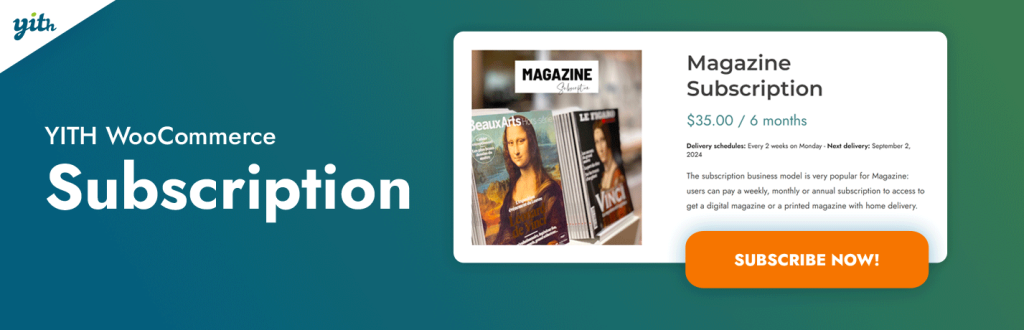
YITH is a dominant force in the WooCommerce ecosystem, known for building highly specialized premium plugins. Their subscription offering is positioned as a feature-rich alternative to the official extension, offering unique merchandising tools.
The Core Features
YITH distinguishes itself by focusing heavily on the physical fulfillment side of subscriptions.
- The Subscription Box Feature: YITH is highly regarded for its exclusive, native solution for selling themed subscription boxes. It allows customers to curate their own boxes step-by-step, making it ideal for cosmetic, food, or toy deliveries.
- Synchronized Renewals: Allows you to force all recurring payments to trigger on a specific day of the month, streamlining warehouse logistics.
- Printable Dispatch Lists: Natively generates PDF address lists for easy physical mailing management.
The Pricing and Total Cost of Ownership
- Base Price: Starts at €199.99 per year (approximately $215 USD) for a single site.
- The Hidden Costs: While cheaper than the official extension, YITH plugins are notorious for operating in silos. If you want to add membership content restrictions or advanced product bundles alongside your subscriptions, you must buy individual YITH plugins for each feature, which quickly negates the initial savings.
Pros and Cons
- Pros: The undisputed best choice for curating complex physical subscription boxes; excellent multi-language support (WPML); strong visual customization options for the customer dashboard.
- Cons: Still carries a high premium price tag at €199.99/year; relies on the traditional “fragmented plugin” architecture, requiring merchants to buy multiple YITH add-ons to achieve full store functionality.
The Verdict: The absolute best option if your entire business model revolves around highly customizable, physical subscription boxes. If you are selling digital goods or simple recurring products, you are overpaying for features you will not use.
3. Subscriptions for WooCommerce (By Themehigh)

Themehigh has built a strong reputation in the WordPress community for creating clean, utilitarian plugins that focus on doing one thing very well without bloating the interface. Their subscription plugin is positioned as the budget friendly, high retention alternative for store owners who need simplicity.
Core Features and Technical Capabilities
Themehigh covers all the mandatory basics (variable subscriptions, sign up fees, Stripe integration) but includes highly strategic retention tools that other plugins ignore.
- Built In Renewal Discounts: This is the standout feature. Store owners can automatically apply percentage or fixed discounts to future renewals to incentivize long term loyalty. For example, you can configure a rule that says, “Pay full price for the first three months, get 10% off all future billing cycles.”
- Clean Admin Interface: The plugin is frequently praised by agency developers for having a modern, highly intuitive backend dashboard. It is significantly easier for non technical clients to navigate than the official WooCommerce extension.
- Mixed Checkout Support: Allows customers to purchase a one time product and a recurring subscription product in the exact same transaction without breaking the payment gateway logic.
The Pricing and Total Cost of Ownership
- Base Price: Priced very aggressively at $89 per year for a single site license.
- The Hidden Costs: Themehigh is a standalone tool. While it handles subscriptions beautifully, it does not handle conversion rate optimization. If you need cart recovery emails for abandoned subscriptions, advanced checkout field editing, or dynamic currency switching for international subscribers, you will still need to purchase and install separate plugins from other developers.
Pros and Cons
- Pros: Highly affordable at $89 per year; the renewal discount feature is a massive win for customer retention and marketing; backed by a trusted development team known for clean, lightweight code.
- Cons: Lacks the enterprise level proration complexity of the official extension; operates as a single purpose tool, meaning you still have to manage a larger stack of third party plugins for other critical store features.
The Verdict: A fantastic, budget friendly option for store owners who want straightforward recurring billing and prioritize long term retention discounts. It is perfect for merchants who want a clean interface and do not require highly complex, mid cycle proration logic.
4. Swift Commerce (The Consolidated Architecture)
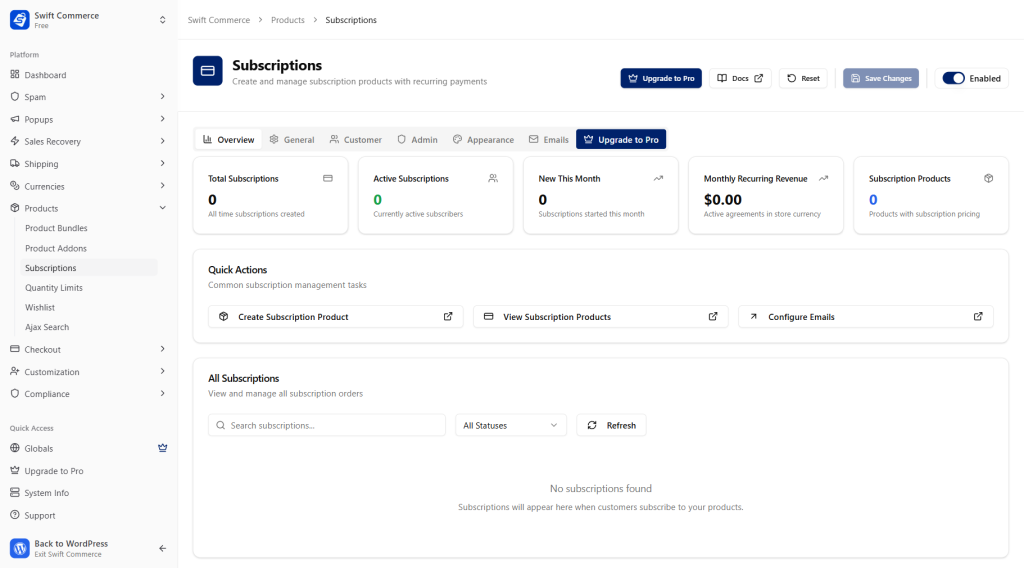
Swift Commerce represents a paradigm shift in how WooCommerce stores are built. Instead of purchasing an isolated subscription tool and hoping it plays nicely with your cart recovery, bundle, and checkout plugins, Swift Commerce consolidates sixteen essential eCommerce features into a single, unified codebase.
The Core Features
Swift Commerce delivers enterprise-grade subscription logic without the bloat.
- Native Proration and Plan Switching: Customers can seamlessly upgrade or downgrade their tiers from a beautiful front-end dashboard, with the system handling the complex mathematical proration automatically.
- Mixed Checkouts and Customization: Customers can buy a one-time product and a recurring subscription in the exact same cart.
- The Ecosystem Advantage: Because Swift Commerce is a unified toolkit, subscriptions interact natively with its other features. You can use Swift Commerce’s built-in Product Addons to let users customize their subscriptions, or use its Cart Recovery Engine to send branded emails if someone abandons a subscription checkout—all without installing extra software.
The Pricing and Total Cost of Ownership
- The Free Tier: Unlike the official extension, Swift Commerce offers a robust, production-ready free version on WordPress.org. This free tier includes subscription creation, variable products, pause/resume functionality, and payment proration.
- The Pro Tier: The premium version (available on swiftcommerce.io) unlocks advanced scaling features like synchronized renewals and free trials, alongside fifteen other premium eCommerce modules (like dynamic currency switching and advanced AJAX search).
- The TCO Advantage: The total cost of ownership is drastically lower because you are replacing $1,000+ worth of fragmented plugins (Subscriptions, Product Bundles, Checkout Editors, Cart Recovery) with one highly optimized framework.
The Performance Benefit (Eradicating Database Bloat)
This is where Swift Commerce mathematically defeats traditional plugins. Every time you install a standalone plugin (like ThemeHigh or YITH), it injects unique CSS/JS files and writes data to your wp_options database table. This autoloaded data destroys your site speed.
By consolidating your subscription logic into the Swift Commerce architecture, you drastically reduce your total plugin count. This minimizes database queries, slashes your Time to First Byte (TTFB), and ensures your checkout page loads instantly—which directly increases your conversion rate.
Pros and Cons
- Pros: The most cost-effective TCO on the market due to the consolidation of 16 features; eradicates plugin conflicts and database bloat; offers a genuinely powerful free tier for startups; native integration with cart recovery and upselling tools.
- Cons: If a merchant only wants a subscription tool and absolutely refuses to utilize the other fifteen CRO features included in the suite, they might prefer a micro-plugin, though they will sacrifice the speed benefits of the unified codebase.
The Verdict: The undeniable best choice for modern, growth-focused merchants. Swift Commerce is not just a subscription plugin; it is a structural upgrade that provides enterprise recurring billing while simultaneously fixing your site speed and reducing your annual software costs.
Visit Subscriptions by Swift Commerce
Conclusion: Which Subscription Plugin Should You Choose?
The decision ultimately comes down to your current business stage and your technical philosophy regarding WordPress management.
- If you are building a highly complex, physical Subscription Box business: You must choose YITH WooCommerce Subscription. Their native box-building tool is currently unmatched in the ecosystem.
- If you have a massive enterprise budget and require highly obscure accounting API integrations: The official WooCommerce Subscriptions ($279/year) remains the safest, albeit most expensive, legacy choice.
- If you want a cheap, standalone plugin just for basic billing and renewal discounts: ThemeHigh ($89/year) is a highly competent, well-coded micro-solution.
However, if you want to scale intelligently, protect your site speed, and stop paying thousands of dollars a year for a fragmented plugin stack, Swift Commerce is the definitive winner.
By choosing a consolidated architecture, you ensure that your recurring billing works in perfect harmony with your checkout editor, your cart recovery emails, and your product bundles. You reclaim your database speed and your operating budget in one strategic move.